Topics Covered:
Helpful tools for this guide
Table of Contents
- Quick Answer
- Key Token Estimates
- 7 Real-World Examples of Word Counts in Tokens
- How the 1,000 Words to Tokens Math Works
- We Tested It With a Real Tokenizer
- Words to Tokens Conversion Table
- Why Can the Same Word Total Produce Different Token Counts?
- Simple Words Versus Uncommon Words
- Punctuation and Symbols
- Does Code Use the Same Number of Tokens as English Text?
- Do GPT, Claude, and Gemini Give the Same Result?
- Does Language Affect Tokens Per Word?
- Words, Characters, and Tokens Are Different
- Why Token Estimates Matter
- When Is a Rough Estimate Good Enough?
- Frequently Asked Questions
- Is 1,000 Words Always About 1,300 to 1,500 Tokens?
- How Many Tokens Are 500 Words?
- How Many Tokens Are 2,000 Words?
- How Many Tokens Are 5,000 Words?
- Does ChatGPT Count Words or Tokens?
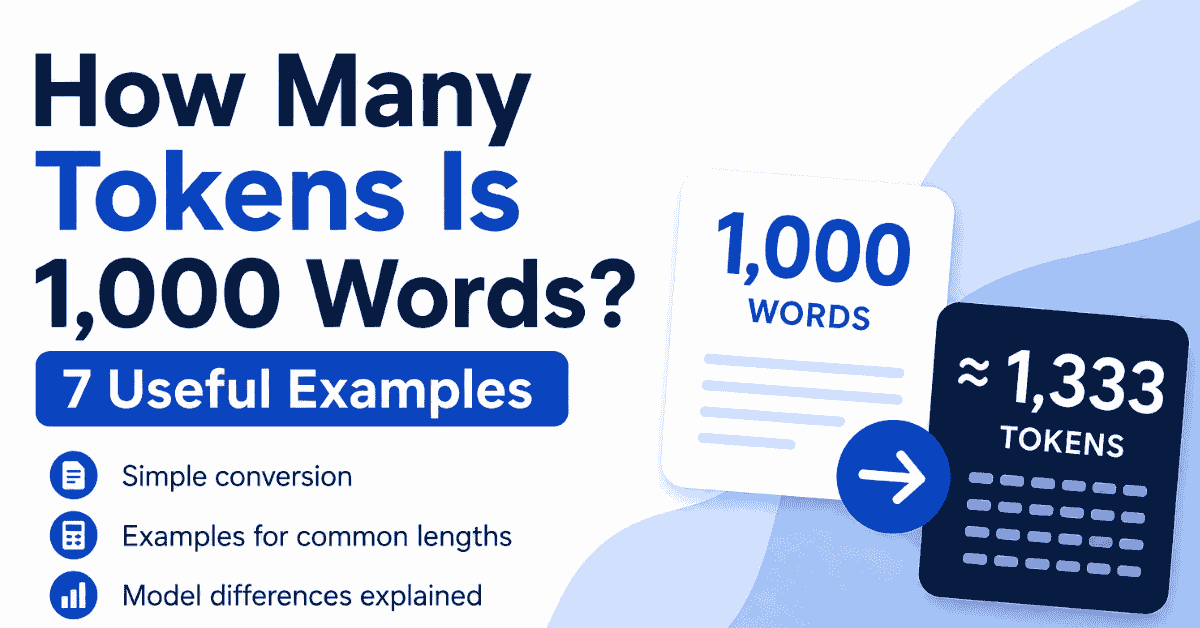
A 1,000 word document does not become 1,000 AI tokens. If you're planning a prompt, article, report, or API request, knowing how many tokens is 1,000 words gives you a useful starting point. For ordinary English, 1,000 words are usually somewhere between 1,100 and 1,500 tokens, and the exact result changes with the model, the writing style, punctuation, code, and formatting.
Quick Answer
1,000 words of standard English text is approximately 1,300 to 1,500 tokens, though the low end of that range can drop closer to 1,100 tokens for simple, conversational writing. Because large language models process text in sub-word pieces rather than whole words, a single word often breaks down into more than one token.
Key Token Estimates
- Standard English Prose: 1 word equals roughly 1.1 to 1.5 tokens, so 1,000 words comes to about 1,100 to 1,500 tokens depending on vocabulary and sentence style.
- Reversed Ratio (Tokens to Words): 1,000 tokens equals roughly 700 to 750 words of English prose.
- Code and Technical Text: Programming code or text with heavy punctuation and specialized jargon uses more tokens per word, often 2 to 3 times higher than plain prose.
- Model Differences: Exact counts vary depending on the tokenizer, typically within 5% to 20%, since GPT, Claude, and Gemini each use their own tokenization system.
Treat 1,300 to 1,500 as a planning range rather than a fixed result. A tokenizer does not simply count spaces between words. It can split long or uncommon words into smaller pieces and processes punctuation, numbers, symbols, and code as separate units.
Quick estimate: 1,000 English words ≈ 1,300 to 1,500 AI tokens.
7 Real-World Examples of Word Counts in Tokens
Raw numbers are easier to use once you can picture what they represent. Here is how 1,000 words compares with other everyday pieces of writing, using a working range of about 1.1 to 1.5 tokens per word.
| Example | Approx. words | Approx. tokens |
|---|---|---|
| A social media caption | 40 | 45 to 60 |
| A short email | 150 | 165 to 225 |
| A product description | 300 | 330 to 450 |
| A blog post introduction | 500 | 550 to 750 |
| A one-page cover letter | 750 | 825 to 1,125 |
| A standard 1,000-word article | 1,000 | 1,100 to 1,500 |
| A long-form guide section | 2,000 | 2,200 to 3,000 |
These figures scale with the same ratio used throughout this guide. For an exact count on your own text instead of an estimate, paste it into the AI Token Counter and Cost Calculator.
How the 1,000 Words to Tokens Math Works
A common shortcut is to divide the word count by 0.7. For 1,000 words, that gives 1,000 ÷ 0.7, or about 1,430 tokens, which sits inside the usual 1,300 to 1,500 range. This follows the general rule that one token covers a little less than a full English word.
The formula cannot see what your text actually contains, though. A casual blog post, a legal document, a Python file, and a JSON response can all show the same word total and still produce very different token totals. If context limits or API cost matter, measure the real text instead of relying only on this shortcut.
We Tested It With a Real Tokenizer
Rules of thumb are useful, but we wanted a measured number instead of only repeating the common estimate. We ran an original 836-word sample of plain narrative English through OpenAI's production tokenizers using the open-source gpt-tokenizer library.
| Tokenizer | Used by | Result on our sample | Per 1,000 words |
|---|---|---|---|
| o200k_base | GPT-4o and newer GPT models | 836 words → 933 tokens | ≈ 1,120 tokens |
| cl100k_base | GPT-4 and GPT-3.5 era models | 836 words → 968 tokens | ≈ 1,160 tokens |
Our result landed below the often-quoted 1,300 to 1,500 range because our sample used short sentences, common words, and light punctuation. Denser writing pushes the ratio up. Formal vocabulary, longer words, numbers, quotation marks, and varied sentence structure all add tokens without adding word count, which is why the widely cited range exists rather than a single fixed number.
We also tokenized individual words to show how sub-word splitting works in practice, using the newer o200k_base tokenizer:
- hello → 1 token
- tokenization → 2 tokens
- extraordinary → 2 tokens
- ChatGPT → 2 tokens
- internationalization → 2 tokens
Common short words usually stay whole. Longer or less common words are often split into two meaningful pieces rather than counted letter by letter, which is why a word count alone cannot predict a token count.
Words to Tokens Conversion Table
You can use the same working range to estimate other common document lengths.
| Words | Approximate tokens |
|---|---|
| 100 | 110 to 150 |
| 250 | 275 to 375 |
| 500 | 550 to 750 |
| 750 | 825 to 1,125 |
| 1,000 | 1,100 to 1,500 |
| 2,000 | 2,200 to 3,000 |
| 5,000 | 5,500 to 7,500 |
| 10,000 | 11,000 to 15,000 |
These figures assume ordinary English prose and are not provider billing totals. For a large conversion in the opposite direction, see the guide on 1 million tokens to words.
Why Can the Same Word Total Produce Different Token Counts?
Words and tokens measure different things. A word counter looks at written words, while tokenization breaks text into units from a model's vocabulary. Common words often fit into one token, while rare names, technical terms, URLs, and unusual spellings can need two or more.
Formatting also matters. Extra punctuation, emojis, markup, code syntax, and structured content can change the result even when the visible word total stays the same. That is why two 1,000-word documents can use different amounts of model context.
Simple Words Versus Uncommon Words
Common English words tokenize efficiently, often as a single token as our own test above shows with "hello." Rare scientific terms, brand names, or unusual vocabulary may split into several pieces, so the token estimate can rise without adding more words.
Punctuation and Symbols
Commas, brackets, quotation marks, mathematical symbols, and similar characters affect tokenization too. Dense formulas or structured syntax behave differently from plain English prose.
Does Code Use the Same Number of Tokens as English Text?
Code should not be estimated from word count alone. In our own test, a 79-word JavaScript snippet came to 188 tokens with the o200k_base tokenizer and 223 tokens with cl100k_base, roughly 2.4 to 2.8 tokens per word, well above plain English prose. Programming languages contain braces, operators, indentation, variable names, and punctuation that don't behave like ordinary sentences.
The same warning applies to JSON, XML, CSV, Markdown, and long URLs. For developer content, paste a representative sample into the AI Token Counter and Cost Calculator rather than applying a general English ratio.
Do GPT, Claude, and Gemini Give the Same Result?
Not always. Model families use different tokenization systems, so the same input can produce different totals, typically within about 5% to 20% of each other for English prose. OpenAI provides tokenizer tools, Google Gemini provides a countTokens method, and Anthropic provides its own token counting endpoint for Claude.
Because providers release new model versions regularly, exact per-model token counts and pricing shift over time. Rather than relying on a version number that can go out of date, compare your actual text across current GPT, Claude, and Gemini models side by side using the AI Token Counter and Cost Calculator, which is kept current as providers update their lineups.
Does Language Affect Tokens Per Word?
Yes. The ranges in this guide are mainly an English planning shortcut. Non-Latin scripts and languages with heavy compounding, such as German, Japanese, Arabic, or Korean, typically need more tokens per word than English does.
For multilingual content, don't rely only on the number of words when accuracy matters. Measure the actual text with the target model or a model-matched counter. This is especially useful for translation tools, international support bots, and multilingual content workflows.
Words, Characters, and Tokens Are Different
These measurements answer different questions. Words help measure writing length, characters show literal text size, and tokens show how a language model processes content. One number cannot safely replace the others.
If you only need writing length, use the Word Counter. For platform limits or literal text size, use the Character Counter. Token measurement matters when checking prompt length, context window usage, or estimated API cost.
| Measurement | Best used for |
|---|---|
| Words | Essays, articles, reports |
| Characters | Forms, social posts, platform limits |
| Tokens | AI prompts, context windows, API usage |
Why Token Estimates Matter
A model's context window limits how much tokenized information it can work with in a single request. Your prompt is only part of that space. System instructions, conversation history, retrieved documents, tool output, and the model's own response can all use up the available context.
Tokens also matter for API planning because providers typically charge separately for input tokens and output tokens. A single request may be cheap, but repeated prompts can add up quickly at scale. See how much 1 million tokens actually costs across current models for a fuller picture, and compare tools in 7 best AI token counters and cost calculators if you want options beyond a single estimate.
When Is a Rough Estimate Good Enough?
A rough conversion works well when you're comparing document sizes or checking whether a short prompt is comfortably below a context limit. In those cases, a range such as 1,300 to 1,500 tokens is more useful than pretending the result is exact.
Greater precision matters when your request sits close to a model limit, when API spend affects a real budget, or when the content contains code, special formatting, or several languages. The closer you are to a hard limit, the more important direct measurement becomes.
Frequently Asked Questions
Is 1,000 Words Always About 1,300 to 1,500 Tokens?
No. That range is a useful English planning estimate, and our own tokenizer test on a plain-language sample came in lower, at about 1,100 to 1,160 tokens per 1,000 words. The actual result depends on the tokenizer and how formal or dense the writing is.
How Many Tokens Are 500 Words?
Using the same planning range, 500 English words are about 550 to 750 tokens. Technical or heavily punctuated content can push that higher.
How Many Tokens Are 2,000 Words?
A quick estimate gives about 2,200 to 3,000 tokens. Measure the actual document when context usage or API cost needs closer checking.
How Many Tokens Are 5,000 Words?
Five thousand English words come to roughly 5,500 to 7,500 tokens using the same range. Formatting, language, and vocabulary can shift the result in either direction.
Does ChatGPT Count Words or Tokens?
Language models process tokenized units rather than ordinary word totals. A token may represent a full word, part of a word, punctuation, or a symbol, which is why a word count and a token count are never quite the same number.
Related Articles
Continue with closely related CountFlows guides.
AI
Why ChatGPT, Claude, and Gemini Stop Mid-Sentence
Discover the three unrelated reasons AI models stop mid-sentence and the exact steps to fix output caps, context window overflows, and connection issues.
AI
Is an Em Dash a Sign of AI? Why AI Uses Em Dashes (2026)
Learn why em dashes are associated with AI writing, why AI tools use them, whether they can identify AI-generated text, and how to remove them when needed.
AI
Why AI Chatbots Can't Count Syllables (And How to Fix Them)
AI chatbots can explain the 5-7-5 haiku rule perfectly, yet still produce lines with the wrong syllable count. Learn why tokens and sounds do not match, why AI-generated lyrics often fail to fit melodies, and how to fix the problem with an external syllable counter.