Topics Covered:
Helpful tools for this guide
Table of Contents
- Quick Answer: How Many Words Is 1 Million Tokens?
- 1 Million Tokens to Words: The Simple Math
- Why can two documents with the same word total use different tokens?
- 1 Million Tokens to Pages
- Does this token volume always equal 1,500 pages?
- Converting Tokens to Characters
- 1 Million Tokens to Lines of Code
- How Much Is 1 Million Tokens in GPT-5.6, Claude Opus 4.8, or Gemini?
- Common Tokens to Words Conversions
- Why Does the Token to Word Estimate Change?
- When Should You Use a Token Calculator Instead of an Estimate?
- Frequently Asked Questions
- How many words is 1 million tokens?
- How many pages could this amount represent?
- How many characters does this token volume contain?
- Does the same text use equal tokens in GPT-5.6, Claude, and Gemini?
- How much would this amount of AI usage cost?
- Can tokens be converted directly into lines of code?
- Final Takeaway
This token volume can be difficult to visualize until you convert it into familiar units such as words, pages, and characters. If you're planning a long prompt, document workflow, research archive, or API budget, knowing 1 million tokens to words gives you a practical starting point. For ordinary English prose, the quick estimate is about 750,000 words, but language, formatting, code, punctuation, and the tokenizer can change the result.
Quick Answer: How Many Words Is 1 Million Tokens?
For common English text, 1 million tokens to words works out to roughly 750,000 words using the usual estimate of one token for about three-quarters of a word. Leading AI providers like OpenAI and Anthropic use about four characters per token and about 0.75 words per token as standard rules of thumb.
Still, 750,000 words is an estimate, not a fixed conversion. Tokenizers can split text into full words, pieces of words, punctuation, spaces, symbols, and other units. Different models and languages can therefore produce different totals from text that looks similar to you.
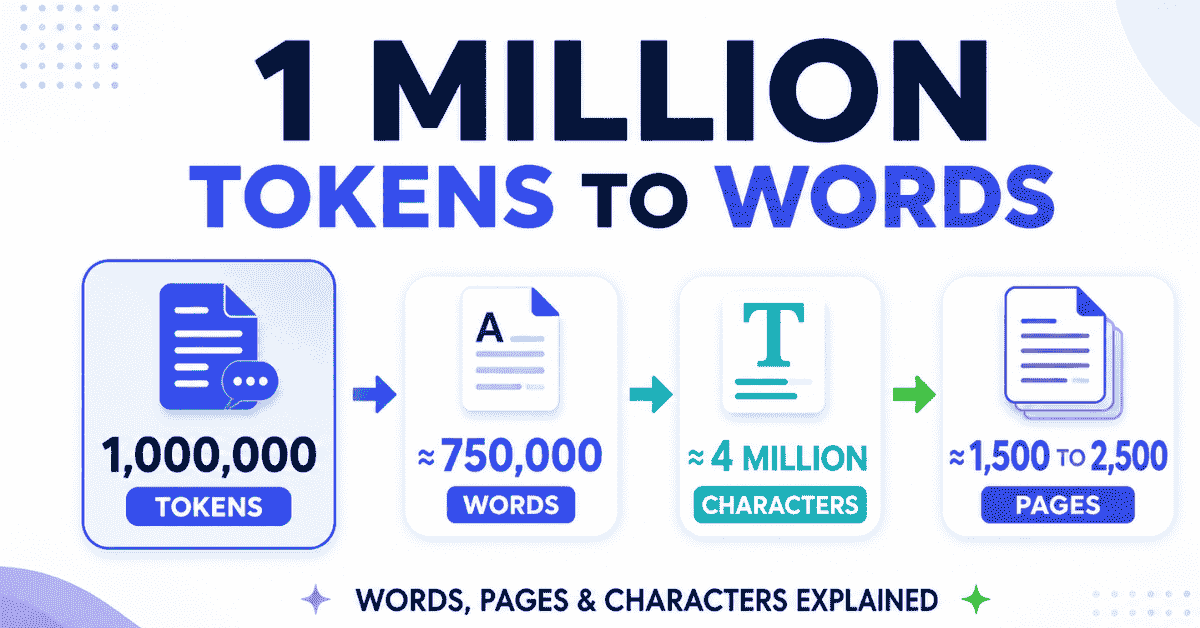
Quick estimate: 1,000,000 tokens ≈ 750,000 English words ≈ 4,000,000 characters ≈ 7 full-length novels.
1 Million Tokens to Words: The Simple Math
The common English shortcut is simple: multiply the token total by 0.75. Using that rule, 1,000,000 tokens × 0.75 gives about 750,000 words. OpenAI and other platforms describe the same relationship as 100 tokens being roughly 75 English words.
However, don't treat the result as an exact model count. If you have the actual prompt, document, code, or dataset, paste it into the AI Token Counter & Cost Calculator. Measuring the real text is more useful than estimating from words when context limits or API costs matter.
Why can two documents with the same word total use different tokens?
Vocabulary, punctuation, spacing, language, numbers, code, and tokenizer rules all affect segmentation. Technical writing with uncommon terms, URLs, or structured data may tokenize differently from ordinary English prose.
1 Million Tokens to Pages
Converting this token volume into pages requires an assumption because a page has no fixed word capacity. Starting with about 750,000 words, a dense page with 500 words gives roughly 1,500 pages. A 300 word page gives about 2,500 pages.
Formatting changes the answer quickly. Font size, margins, headings, tables, citations, images, and spacing affect visible page length without changing the underlying text. For AI work, pages are a visual comparison, while tokens remain the useful unit for context windows and billing.
| Words per page | Approximate pages |
|---|---|
| 250 | 3,000 |
| 300 | 2,500 |
| 400 | 1,875 |
| 500 | 1,500 |
Does this token volume always equal 1,500 pages?
No. That estimate assumes about 500 words per page and ordinary English prose. Academic papers, PDFs with tables, or heavily formatted documents can occupy far more pages for the same text volume.
Converting Tokens to Characters
Provider rules of thumb suggest about four English characters per token. At this scale, the text would contain roughly 4 million characters, though the exact total depends on the content. That figure is still approximate because tokenization doesn't simply cut every four characters into one unit. Spaces, punctuation, Unicode characters, numbers, and language patterns matter. If you only need literal text length, use the Character Counter instead.
1 Million Tokens to Lines of Code
There is no reliable universal conversion from this token volume to lines of code. One line can contain a single brace, while another may contain a long function call, SQL statement, JSON object, comment, or generated string. Programming language, indentation, naming style, and formatting all change the ratio.
A fixed claim that this amount equals a specific number of code lines can be misleading because code structure varies widely. A better method is to measure a representative code sample, calculate its token usage, and scale from your own codebase.
How Much Is 1 Million Tokens in GPT-5.6, Claude Opus 4.8, or Gemini?
This token volume represents a large amount of model-readable information. Modern state-of-the-art models like GPT-5.6, Claude Opus 4.8 / Sonnet 5, and Gemini 3.6 / 3.1 handle multi-million token context windows effortlessly, but tokenization counts can vary slightly across different model architectures.
For text size, about 750,000 English words remains a useful planning estimate. For pricing details, check our dedicated guide on how much 1 million tokens cost across various API tiers.
Common Tokens to Words Conversions
Search suggestions around this topic include 500 tokens to words, 5,000 tokens to words, and tokens to words calculator. The table below uses the same 0.75 English words per token shortcut for quick planning.
| Tokens | Approximate English words |
|---|---|
| 100 | 75 |
| 500 | 375 |
| 1,000 | 750 |
| 5,000 | 3,750 |
| 10,000 | 7,500 |
| 100,000 | 75,000 |
| 500,000 | 375,000 |
| 1,000,000 | 750,000 |
These values are estimates, not billing counts. For a real prompt, document, code sample, or multilingual text, measure the actual content. If you are starting with words rather than tokens, our guide on how many tokens are in 1,000 words covers the reverse conversion.
Why Does the Token to Word Estimate Change?
English prose is where the 0.75 words per token shortcut works best as a rough planning rule. Providers note that tokenization varies by language and that punctuation, spaces, and partial words contribute to the final result.
Several content types can shift the ratio:
- Code and JSON: symbols, braces, keys, and short strings affect tokenization.
- Non English text: different scripts and language patterns can use tokens differently.
- Technical vocabulary: uncommon terms may split into several pieces.
- URLs and identifiers: structured strings don't behave like normal prose.
If copied material contains unwanted formatting, the AI Text Cleaner can clean the version you intend to measure. For text copied from PDFs, removing extra line breaks can restore normal paragraph flow first.
When Should You Use a Token Calculator Instead of an Estimate?
Use a rough conversion when you only need a sense of scale. It can help you judge whether this token volume represents a short document, a book-length text, or a much larger collection. It isn't enough when your prompt sits close to a context limit or when API usage affects a real budget.
Use the actual calculator when you need context window usage, model comparison, input and output cost, or measurements for code and structured data. If document length is all you need, the Word Counter is simpler because it measures words directly.
Best rule: estimate for planning, measure the real text before deployment.
Frequently Asked Questions
How many words is 1 million tokens?
For ordinary English prose, this token amount is roughly equivalent to 750,000 words, based on the common estimate of about 0.75 words per token. Exact results vary by model, language, punctuation, and content type.
How many pages could this amount represent?
About 750,000 words would equal roughly 1,500 pages at 500 words per page. At 300 words per page, the same text volume would be closer to 2,500 pages.
How many characters does this token volume contain?
A common English planning estimate is about four characters per token. At this scale, that works out to roughly four million characters, although the exact result varies with the text.
Does the same text use equal tokens in GPT-5.6, Claude, and Gemini?
Not necessarily. The same source text can produce different totals because tokenizer behavior varies between model families and providers.
How much would this amount of AI usage cost?
AI pricing depends on whether you are using models like GPT-5.6 or Claude Opus 4.8, and varies by input versus output tokens. Please refer to our detailed token pricing guide for exact cost breakdowns.
Can tokens be converted directly into lines of code?
Not reliably. Code length varies by programming language, formatting, comments, naming style, and structure, so measuring a representative code sample gives a more useful estimate.
Final Takeaway
For ordinary English planning, 1 million tokens to words is about 750,000 words. The same rough guidance suggests about four million characters, while page estimates depend on how many words you place on each page.
Treat these conversions as orientation, not exact billing data. The final token count depends on the actual text, model, tokenizer, language, punctuation, code, and formatting.
Before sending a large prompt or budgeting an AI workflow, check the real content in the AI Token Counter & Cost Calculator. You'll get a better basis for context fit and estimated cost than you would from a words only conversion.
Related Articles
Continue with closely related CountFlows guides.
AI
Why ChatGPT, Claude, and Gemini Stop Mid-Sentence
Discover the three unrelated reasons AI models stop mid-sentence and the exact steps to fix output caps, context window overflows, and connection issues.
AI
Is an Em Dash a Sign of AI? Why AI Uses Em Dashes (2026)
Learn why em dashes are associated with AI writing, why AI tools use them, whether they can identify AI-generated text, and how to remove them when needed.
AI
Why AI Chatbots Can't Count Syllables (And How to Fix Them)
AI chatbots can explain the 5-7-5 haiku rule perfectly, yet still produce lines with the wrong syllable count. Learn why tokens and sounds do not match, why AI-generated lyrics often fail to fit melodies, and how to fix the problem with an external syllable counter.