Topics Covered:
Helpful tools for this guide
Table of Contents
- How a Speech Time Calculator Works
- Why Every Speech Calculator Gives a Different Number
- What Is the Average Speaking Speed?
- Words to Minutes: The Full Speech Length Table
- How Many Words Is a 3 Minute Speech?
- How Many Words for a 5 Minute Speech?
- How Many Words for a 10 Minute Speech?
- How Many Words for a 15 Minute Speech?
- Find Your Real Speaking Speed in Two Minutes
- Write 10 Percent Short, and Pause Without Fear
- FAQ
- How many words is a 1 minute speech?
- How many pages is a 10 minute speech?
- Is a speech time calculator the same as a words per minute calculator?
- Why do I run over even when my word count fits?
- Is speaking speed the same as reading speed?
- How many words per minute is too fast for a speech?
- The Bottom Line
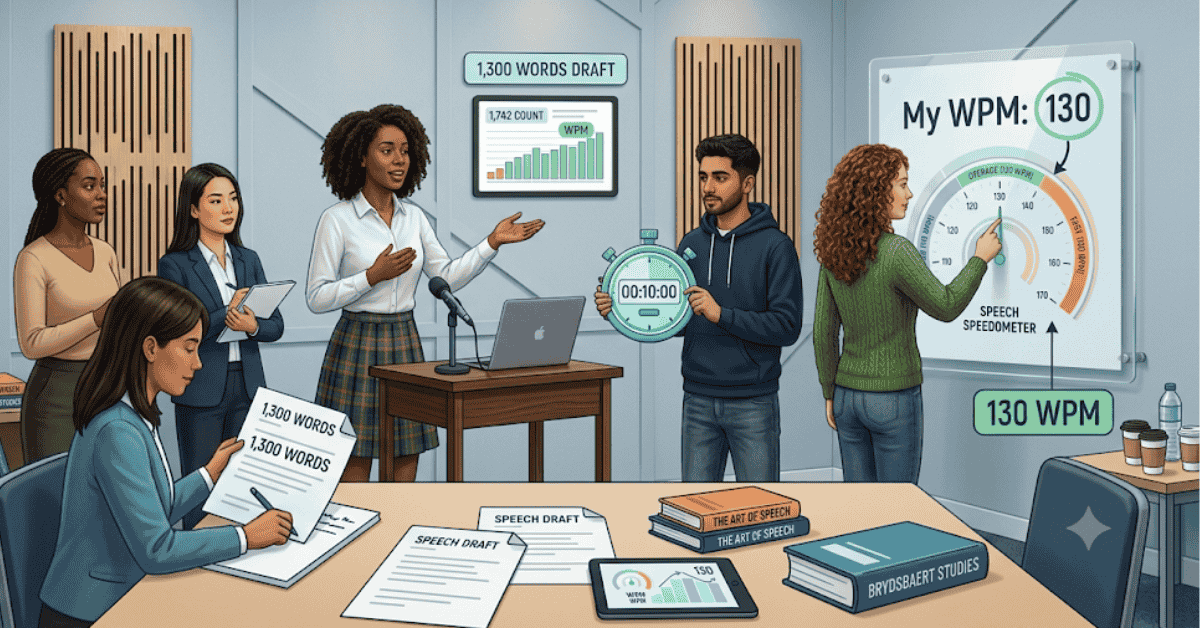
The invitation says ten minutes. Your draft says 1,742 words. Nothing anywhere tells you whether those two facts can live together, and most speakers find out the hard way, on stage, watching the moderator point at the clock. This guide settles it beforehand, working like a speech time calculator you can read: word budgets for 3, 5, 10, and 15 minute speeches, the studies those numbers actually come from, and a stopwatch drill that swaps the averages for your own pace. Short on time? Drop your draft into the free Reading Time Calculator and let it do the math.
Key takeaways
- Plan around 130 WPM. Real speakers range anywhere from 110 to about 160 in a prepared talk, but 130 is the figure that rarely burns anyone.
- The budgets: 390 words for 3 minutes, 650 for 5, 1,300 for 10, and 1,950 for 15.
- Speaking is slower than reading. People read silently at 238 WPM and aloud at 183 (Brysbaert, 2019). On stage, the number falls again.
- Test yourself once. Two minutes and a stopwatch will tell you more than any table on the internet, including the ones below.
- Then cut 10 percent. Pauses, laughs, and slide changes bill you in seconds that no word count records.
How a Speech Time Calculator Works
Underneath every tool sits a single division. Take your word count, divide it by your pace in words per minute, and the result is your minutes on stage. Planning runs the equation backwards: multiply the minutes you were given by your pace, and you get the words you are allowed.
The pace figure is where estimates go wrong, because the mouth and the eyes run on different clocks. In the largest review of reading rates to date, Marc Brysbaert pooled 190 studies with around 18,500 participants and put silent reading at 238 WPM against just 183 WPM for reading aloud (Brysbaert, 2019). Stand that same reader on a stage, add pauses, emphasis, and eye contact, and the rate settles somewhere between 110 and 160.
The Reading Time Calculator handles the division for you and returns reading and speaking figures side by side, so a seconds-to-minutes slip never wrecks the estimate.
Why Every Speech Calculator Gives a Different Number
Type the same 500 words into three different tools and you will collect three different answers. One assumes 125 WPM, another 140, a third 150, and most never disclose the assumption. The tools disagree about the speaker, not about the math.
Everything on this page runs on 110, 130, and 160 WPM for slow, average, and fast. Those brackets come from measured speech research rather than habit, and they mirror how CountFlows estimates speaking time. Any page that prints one flat answer without naming a pace is rounding on your behalf.
What Is the Average Speaking Speed?
Most people delivering a prepared talk in English land between 110 and 160 WPM. Baruch College's Tools for Clear Speech program measures everyday conversation near 150 WPM and coaches speakers down toward 140 when clarity matters most (Tools for Clear Speech, Baruch College).
Laboratory timings agree. When researchers measured young adults for the Journal of Fluency Disorders, even the slowest talkers produced 136 to 144 WPM in conversation, and the same people accelerated to 174 to 186 WPM once they read from a page (Journal of Fluency Disorders, 1999). A rehearsed speech sits below conversation because the pauses are deliberate.
| Pace | Average speaking WPM | Best for |
|---|---|---|
| Slow and deliberate | 100 to 110 | Eulogies, technical detail, non-native audiences |
| Average prepared talk | 130 | Most speeches and presentations |
| Conversational | 140 to 150 | Podcasts, workshops, Q&A |
| Fast | 160 to 170 | Energetic pitches, tight slots |
Material moves the number too. Statistics and technical terms drag your average speaking WPM down, while adrenaline shoves it up. One timed rehearsal exposes both effects before the audience does.
Words to Minutes: The Full Speech Length Table
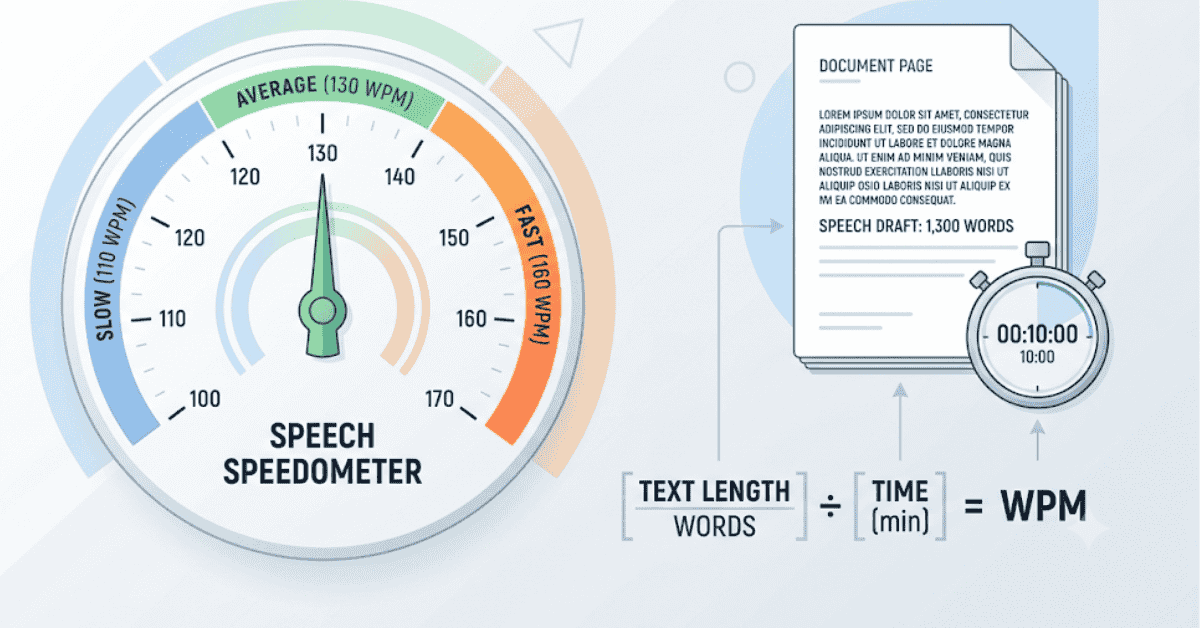
Here is the output a speech time calculator would print for eleven common slot lengths at the three preset paces. Verify your draft with the Word Counter before you plan with it; document footers often count titles and speaker notes you will never say aloud.
| Speech length | Word count at 110 WPM (slow) | Word count at 130 WPM (average) | Word count at 160 WPM (fast) |
|---|---|---|---|
| 1 minute | 110 | 130 | 160 |
| 2 minutes | 220 | 260 | 320 |
| 3 minutes | 330 | 390 | 480 |
| 5 minutes | 550 | 650 | 800 |
| 7 minutes | 770 | 910 | 1,120 |
| 10 minutes | 1,100 | 1,300 | 1,600 |
| 15 minutes | 1,650 | 1,950 | 2,400 |
| 20 minutes | 2,200 | 2,600 | 3,200 |
| 30 minutes | 3,300 | 3,900 | 4,800 |
| 45 minutes | 4,950 | 5,850 | 7,200 |
| 60 minutes | 6,600 | 7,800 | 9,600 |
How Many Words Is a 3 Minute Speech?
Three minutes of stage time equals a script of roughly 390 words when you deliver at the typical 130 WPM. A deliberate speaker lands nearer 330, a hurried one squeezes in 480, and in every case the full text sits inside one page of single-spaced type.
Toasts, elevator pitches, and introductions live in this slot, and the format is ruthless: one idea, delivered once, with no detours. Try 60 words for the opening, about 270 for the single idea and its example, and 60 for the exit line. Any sentence serving a second idea is a sentence you cut.
How Many Words for a 5 Minute Speech?
A 5 minute speech holds close to 650 words at the standard 130 WPM. Deliberate speakers should stop near 550, while a quick talker can push toward 800. That footprint matches a short blog post, which explains why five minutes reads comfortably in your notes and then vanishes on stage (how long should a blog post be).
The length carries an opening, two or three supporting points, and a genuine ending, which is why teachers, best men, and team leads all get handed this slot. Split the middle evenly. An argument that gets 60 seconds while its neighbor gets three minutes sounds unfinished, not concise.
How Many Words for a 10 Minute Speech?
A 10 minute speech works out to roughly 1,300 words for a typical delivery, and real speakers span everything from 1,100 to 1,600. In page terms, expect around two and a half sheets single-spaced, or five once you double the spacing, set in ordinary 12 point type.
Conference sessions and class presentations default to this slot. Presenting with slides? Cap the deck near ten and shave around 100 words from the script, because advancing, glancing, and waiting for the room all draw from the same ten minutes your words do.
How Many Words for a 15 Minute Speech?
A 15 minute speech needs a script in the neighborhood of 1,950 words at 130 WPM, and the honest range runs 1,650 to 2,400. Printed out, that is four pages single-spaced, or eight once the spacing doubles.
Structure earns its keep at this length: an opening, three or four signposted sections, and a closing line worth repeating. Draft toward 1,800 and put the pen down. Conference papers blow through 15 minute slots constantly because nobody budgets for water, laughter, or a clicker that refuses to click. Comparing spoken delivery with silent reading on long material? See how long it takes to read 10,000 words.
Find Your Real Speaking Speed in Two Minutes
The tables approximate. A stopwatch does not.
- Choose 250 to 300 words from the script you will actually deliver, and verify the count before you start.
- Stand up and perform it at the volume you will use in the room, timing yourself as you go.
- Divide words by minutes. Finishing 280 words in two minutes puts you at 140 WPM. Worked examples live in how to calculate words per minute.
- Multiply that WPM by your slot. A 140 WPM speaker with ten minutes owns a 1,400 word ceiling.
Repeat the drill once fresh and once tired, then trust the lower result. A figure well past 160 usually signals rushing, not a naturally quick mouth. For the silent version of the experiment, run the fast reading test and place your score on the average reading speed benchmarks.
Write 10 Percent Short, and Pause Without Fear
A word count knows nothing about the beat after your strongest statistic, the joke that lands, or the projector that dies for ten seconds. Protect yourself by drafting a tenth under budget: 1,170 words for a ten minute slot, not 1,300.
The pause costs your audience nothing. Researchers at McMaster and Ghent universities found listeners process speech efficiently at rates near their own reading speed, around 269 WPM, which is far beyond anything you will say on stage (Journal of Experimental Psychology, 2021). Comprehension has headroom to spare. Clarity does not. Breathe, hold the silence, and let it underline the sentence you just finished.
FAQ
How many words is a 1 minute speech?
Roughly 110 to 160 words, with 130 as the safe middle. Treat it as one strong paragraph: write it, say it against a timer, and trim whatever spills over.
How many pages is a 10 minute speech?
Around 2.5 pages single-spaced or 5 double-spaced, assuming 1,300 words in 12 point type. Scale up to about 4 and 8 pages for a 15 minute speech.
Is a speech time calculator the same as a words per minute calculator?
They run the same equation in opposite directions. Feed a words per minute calculator your time and word count and it returns your rate. Feed a speech time calculator your word count and rate and it returns your time. One paste into the CountFlows tool covers both.
Why do I run over even when my word count fits?
Because delivery spends time that text never shows: transitions, reactions, asides, and pauses. Time a full rehearsal out loud and trim a tenth from the script.
Is speaking speed the same as reading speed?
No. The averages stack up as 238 WPM for silent reading, 183 for reading aloud (Brysbaert, 2019), and 110 to 160 for a prepared talk. Same words, three different clocks.
How many words per minute is too fast for a speech?
Once you pass about 170 WPM, listeners keep up with the words but lose the stress patterns that tell them what matters. Around 140 WPM keeps first-time comprehension intact.
The Bottom Line
Every slot hides a word budget: near 390 words for 3 minutes, 650 for 5, 1,300 for 10, and 1,950 for 15 at an average pace. Test your own WPM once, draft a tenth under the ceiling, and rehearse out loud twice before the day. After that, let a speech time calculator carry the arithmetic: drop the final script into the Reading Time Calculator above, read the speaking estimate, and check again after every edit. Count the clock before it counts you.
Related Articles
Continue with closely related CountFlows guides.
Writing & Education
Academic Writing Guide: Structure, Examples & Tips for Students
A practical guide to academic writing, including structure, evidence, paragraph building, assignment command words, examples, citations, and editing.
Writing & Education
Essay Word Count Guide: How Long Is an Essay? (By Level)
Word count problems start at the outline stage, not the writing stage. Learn essay lengths by level, paragraph word counts, the exact 10% rule for common lengths, and where your word count actually goes.
Writing & Education
How Many Pages Is 2,000 Words? Single & Double Spaced
A standard page holds about 500 words single-spaced or 250 words double-spaced. See page estimates for essays, books, handwriting, speeches, and common word counts.