Topics Covered:
Helpful tools for this guide
Table of Contents
- What Counts as an Average Reading Speed?
- Why Do Reading Speed Numbers Differ Across the Internet?
- Average Reading Speed by Type
- Average Reading Speed by Age and Grade Level
- Why Reading Speed Plateaus in Adulthood
- How Many Pages Per Hour Is Normal?
- What Is a Good Reading Speed? It Depends on Your Purpose
- Reading Speed vs Reading Comprehension: The Trade-off
- What Counts as Speed Reading?
- Is My Reading Speed Slow? (Probably Not)
- Find Your Own Reading Speed in Under a Minute
- FAQ
- What is the average reading speed for an adult?
- Why do different websites list different average reading speeds?
- What is a good reading speed?
- Is 200 WPM a slow reading speed?
- How many pages per hour is normal?
- How long does it take to read 100 pages?
- Is reading 100 pages an hour fast?
- Is 30 pages an hour slow?
- Is 2 minutes per page slow?
- Is reading 400 WPM fast?
- Is reading 20 pages an hour slow?
- Does reading speed change with age?
- Does reading faster reduce comprehension?
- Can I increase my reading speed without losing comprehension?
- What reading speed do I need for college?
- What is considered speed reading?
- Conclusion
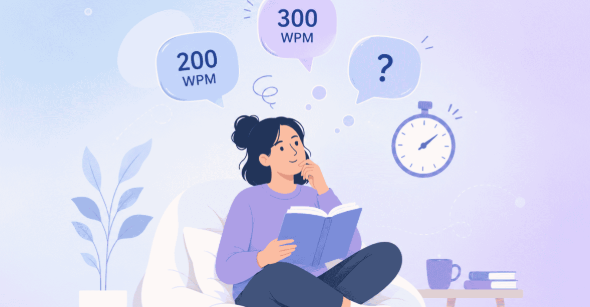
You see "250 words per minute" on one site and "300 WPM" on another, then a third claims the average is 200. None of them explain why the numbers don't match, so you're left with no real way to know if your reading speed is actually fine. This guide breaks down the real average reading speed, why sources disagree on the exact figure, how speed connects to reading comprehension, and how to find your own number in under a minute. For a quick personal estimate, try our Reading Time Calculator.
What Counts as an Average Reading Speed?
A huge meta-analysis published in the Journal of Memory and Language — one that pooled 190 separate studies with over 18,500 readers — put the typical adult's silent pace at 238 words per minute on non-fiction material. No larger reading-rate review exists; Marc Brysbaert's 2019 project at Ghent University remains the biggest of its kind, which is exactly why 238 WPM is the number worth trusting.
Stories move a little quicker than factual text — fiction lands near 260 WPM — while reading out loud drags the pace down to about 183 WPM. So whenever you hunt for the average reading speed in words per minute, the honest answer sits somewhere inside the 200-to-300 window.
The majority of adult readers land inside that same 200–300 band. Sitting anywhere within it while still understanding what you read means your pace is perfectly normal.
Why Do Reading Speed Numbers Differ Across the Internet?
Here's what other guides gloss over: the average reading rate changes depending on what was tested.
- Silent vs. aloud reading produces different numbers.
- Fiction vs. non-fiction produces different numbers.
- A meta-analysis of 18,500 people is far more reliable than a single test of a few dozen college students.
Older, smaller studies produced higher estimates — that is why outdated pages still cite 300 WPM as the average reading speed. Modern, large-scale research puts the reliable adult average in the 230 to 260 WPM range.
When you see wildly different average reading speeds on different websites, this is the reason.
Average Reading Speed by Type
| Reading Type | Average WPM |
|---|---|
| Reading aloud | 183 |
| Silent reading, non-fiction | 238 |
| Silent reading, fiction | 260 |
| Skimming for main idea | 400+, lower recall |
Skimming looks impressive on paper, but it comes at the cost of comprehension. A high WPM number means little if you cannot recall what you just read — raw speed alone is never the full picture of your reading ability.
Average Reading Speed by Age and Grade Level
Reading pace builds year after year through childhood, then flattens out somewhere in the late teens.
| Grade / Age | Typical WPM Range |
|---|---|
| 1st grade (6–7) | 50 to 110 |
| 3rd grade (8–9) | 100 to 160 |
| 5th grade (10–11) | 135 to 195 |
| 8th grade (13–14) | 150 to 205 |
| High school (14–18) | 200 to 300 |
| College students | 250 to 350 |
| Adults | 200 to 260 |
Grade-level ranges are adapted from Hasbrouck & Tindal's (2017) oral reading fluency norms and Brysbaert's (2019) adult silent-reading review, compressed into approximate bands rather than exact percentiles.
Why Reading Speed Plateaus in Adulthood
Progress is quickest in young children and slows through the teenage years. Once a reader reaches adulthood, the average reading rate typically stops rising and plateaus instead — this is entirely natural and does not mean stagnation.
How Many Pages Per Hour Is Normal?
Most readers don't measure themselves in words per minute — they think in pages. At the average silent reading speed of 238 WPM, and with a typical paperback holding 250–300 words per page, the average reader gets through 40 to 55 pages per hour.
| Reading Speed | Pages Per Hour (typical paperback) |
|---|---|
| 150 WPM (slower reader) | 25–35 pages |
| 238 WPM (average) | 40–55 pages |
| 300 WPM (fast) | 55–70 pages |
| 400+ WPM (skimming) | 80+ pages, reduced recall |
If you read 20–30 pages an hour, that's still a normal pace for many readers — dense non-fiction, small fonts, note-taking, and unfamiliar topics all cut page counts down. A textbook page can hold 800 words, close to three paperback pages' worth of text, so the same reader can look "slow" on one book and "fast" on another purely because of formatting.
What Is a Good Reading Speed? It Depends on Your Purpose
There is no single ideal number — purpose decides everything. Casual reading works fine anywhere from 200 to 300 WPM with solid comprehension, while absorbing brand-new material at 100 to 200 WPM is completely normal.
So when people ask "how many words can the average person read per minute," the real answer depends on context. Reading a novel for enjoyment and studying a textbook for an exam will produce two very different speeds from the same person.
Reading Speed vs Reading Comprehension: The Trade-off

Faster does not always mean better. Push past the 400–500 WPM mark and reading comprehension collapses — not from any lack of skill, but because of the physical way eyes pull information off a page. Vision works in brief stops (fixations) and rapid hops (saccades), and no amount of training removes that mechanical ceiling.
That is why WPM alone is an unreliable measure. Two people can both read at 300 WPM, yet one remembers everything while the other retains only the general idea. If you want an honest picture of your reading ability, always measure speed together with comprehension.
What Counts as Speed Reading?
Speed reading usually describes any pace past 400 WPM — nearly double the 238 WPM norm. Plenty of courses advertise four-digit speeds, yet barely one reader in a hundred ever performs at that level on a real test, and what happens up there looks far more like skimming than genuine reading.
Cognitive scientists remain skeptical of extreme speed reading claims because the eye's fixation-and-saccade mechanics cap meaningful reading at roughly 500 WPM. Speed reading techniques like chunking and suppressing subvocalization can raise your pace moderately, but if your goal is retention, a moderate speed with high comprehension beats extreme speed reading every time.
Is My Reading Speed Slow? (Probably Not)
If you've ever seen someone online claim they read 600 words per minute and felt behind, here's the reality: most people quoting extreme numbers are skimming, estimating generously, or both.
Reading at 150–200 WPM with strong comprehension is a completely functional reading speed. Slower reading while studying, taking notes, or working through scholarly material is not a weakness — it's what deep comprehension actually looks like. If you're a student working through dense academic texts, our Academic Writing Guide explains why formal scholarly writing is designed to be read slowly and carefully.
Find Your Own Reading Speed in Under a Minute
Averages give you a benchmark, but they can't tell you where you stand. Paste any passage into the Reading Time Calculator to see your actual reading time in seconds — no manual math needed.
If you're testing yourself on a full document rather than a short passage, run it through the Word Counter Tool first to get an exact word count.
FAQ
What is the average reading speed for an adult?
For silent reading, most adults land in the 200–260 WPM zone — roughly 238 WPM on non-fiction, and a touch quicker (about 260 WPM) on fiction.
Why do different websites list different average reading speeds?
The figure depends on what was tested — silent vs. oral reading, fiction vs. non-fiction, and the size of the study sample all change the average. That's why numbers range between 200 and 300 WPM.
What is a good reading speed?
For everyday adult reading, any pace from 200 to 300 WPM paired with solid comprehension qualifies as good.
Is 200 WPM a slow reading speed?
No. 200 WPM is within the normal adult range. The meta-analysis average for silent non-fiction reading is 238 WPM, so 200 WPM with good comprehension is entirely typical.
How many pages per hour is normal?
A typical paperback goes by at 40–55 pages per hour for most adults, and anything from 30 to 60 pages sits comfortably within the normal range.
How long does it take to read 100 pages?
Around 3 to 3.5 hours for a typical book at an average pace of 238–250 WPM. Dense textbooks packing roughly 800 words onto each page can take double that.
Is reading 100 pages an hour fast?
Yes — 100 pages an hour works out to well over 400 WPM for a typical paperback, which is above the average adult pace. That's realistic for light, familiar material read quickly, but it's worth double-checking your recall at that speed rather than assuming comprehension kept pace.
Is 30 pages an hour slow?
Not necessarily. Thirty pages an hour lines up with roughly 125–180 WPM on a typical paperback, which is a normal pace for denser non-fiction, a second language, or unfamiliar subject matter. It's on the slower side for light fiction, but comprehension matters more than the page count.
Is 2 minutes per page slow?
Two minutes per page works out to roughly 125–150 WPM for a typical paperback page — slower than the 238 WPM adult average, but well within a normal range for technical material, a textbook, or careful study reading.
Is reading 400 WPM fast?
Yes, 400 WPM is faster than the average adult pace of 238 WPM and sits right at the point where most research shows comprehension starts to slip. It's achievable for easy, familiar material, but treat a comprehension check as mandatory at that speed.
Is reading 20 pages an hour slow?
For dense, technical, or academic material, 20 pages an hour is normal. For light fiction it's on the slower side, but comprehension matters more than raw pace.
Does reading speed change with age?
Yes. Pace keeps building through childhood and the teen years before flattening out in adulthood. Some slowdown in later life is also expected and nothing to worry about.
Does reading faster reduce comprehension?
Beyond roughly 400–500 WPM, yes — reading comprehension drops sharply because of the physical limits of eye movement. Below that threshold, moderate speed increases through practice usually preserve comprehension.
Can I increase my reading speed without losing comprehension?
To a degree, yes — mainly through consistent practice, previewing texts, and building vocabulary rather than shortcuts. Pushing speed too far past your natural pace always costs retention.
What reading speed do I need for college?
For general material, college students usually manage 250–350 WPM. Textbook study for retention runs far slower — 100 to 200 WPM — and that drop is both normal and necessary.
What is considered speed reading?
Anything past 400 WPM is usually labeled speed reading. Claims in the 700–1,000+ range almost always involve skimming, because eye-movement limits rule out full comprehension at that pace.
Conclusion
The average reading speed is not one fixed figure — it shifts with the type of material and the study being cited. The 200 to 260 WPM benchmark is useful context, but the number that actually matters is yours, measured together with comprehension. Test yourself on a short passage and see where you land in under a minute.
Related Articles
Continue with closely related CountFlows guides.
Writing & Education
Academic Writing Guide: Structure, Examples & Tips for Students
A practical guide to academic writing, including structure, evidence, paragraph building, assignment command words, examples, citations, and editing.
Writing & Education
Essay Word Count Guide: How Long Is an Essay? (By Level)
Word count problems start at the outline stage, not the writing stage. Learn essay lengths by level, paragraph word counts, the exact 10% rule for common lengths, and where your word count actually goes.
Writing & Education
How Many Pages Is 2,000 Words? Single & Double Spaced
A standard page holds about 500 words single-spaced or 250 words double-spaced. See page estimates for essays, books, handwriting, speeches, and common word counts.