Topics Covered:
Helpful tools for this guide
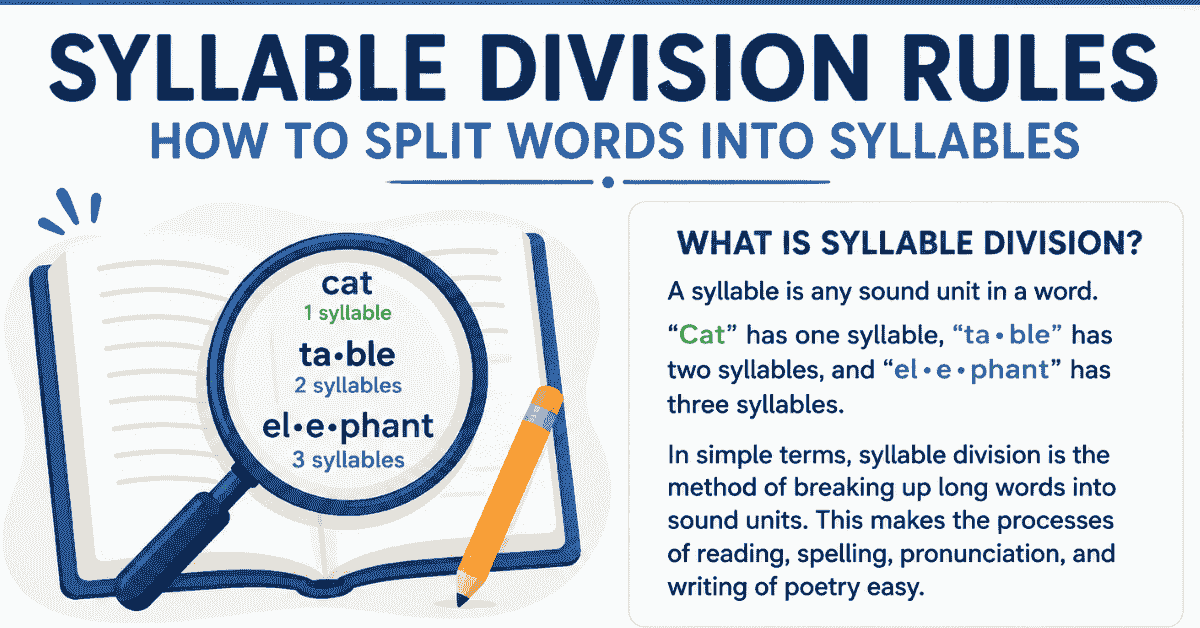
Syllable division helps you break a longer word into smaller, readable parts. The most useful patterns include VCCV, VCV, vowel-to-vowel divisions, consonant plus le, compound words, and meaningful word parts such as prefixes and suffixes.
The important part is not memorizing a slash position for every word. Instead, look at the vowels and consonants, recognize familiar word parts, test a likely division, and check whether the result matches the way the word is actually pronounced.
For example, rabbit can be divided as rab / bit, while tiger works as ti / ger. Both words have two syllables, but they use different division patterns.
Syllable Division in 30 Seconds
When you meet an unfamiliar multisyllable word, use this order:
- Say the word if you know its pronunciation.
- Find the vowel letters or vowel patterns.
- Look at the consonants between them.
- Keep digraphs such as sh, ch, and th together.
- Try the appropriate VCCV, VCV, VV, C-le, or word-part division.
- Identify the syllable types if they help with the vowel sounds.
- Blend the parts back together and check the pronunciation.
This is close to the process used in instructional material from the University of Florida Literacy Institute, which teaches learners to find vowels and consonants, watch for digraphs and blends, divide the word, identify syllable types, and blend the word again.
What Is a Syllable?
A syllable is a unit of pronunciation inside a word. In basic reading instruction, it is usually organized around a vowel sound.
| Word | Syllables | Count |
|---|---|---|
| cat | cat | 1 |
| rabbit | rab / bit | 2 |
| computer | com / pu / ter | 3 |
| information | in / for / ma / tion | 4 |
Do not simply count written vowels. Several vowel letters can work together to represent one vowel sound. For example, rain contains two vowel letters but only one syllable.
Spoken Syllables, Reading Divisions, and Dictionary Breaks Are Not Always the Same
This distinction prevents a lot of confusion.
| What You Are Looking At | Main Purpose | What Matters Most |
|---|---|---|
| Spoken syllables | Hearing and pronunciation | How the word is actually spoken |
| Instructional syllable division | Reading and decoding unfamiliar words | Useful spelling and syllable patterns |
| Morpheme division | Understanding word meaning | Roots, bases, prefixes, and suffixes |
| Dictionary or line-break division | Reference or page layout | The dictionary's own division conventions |
These systems often overlap, but not perfectly. Reading Rockets notes that spoken and written syllable divisions can differ. Merriam-Webster also distinguishes pronunciation syllabification from some printed division marks used for possible line breaks.
That means two reputable resources can sometimes display a word differently without one of them necessarily being wrong. Always check what kind of division the source is showing.
How to Divide a Word Into Syllables
A practical way to work through a new word is:
- Find the vowels. Mark the vowel letters and common vowel teams.
- Check the consonants between them. One consonant and two consonants often lead to different divisions.
- Watch for digraphs. Letter pairs such as sh, ch, th, and ph usually work as one sound unit and should not be split casually.
- Look for recognizable word parts. A compound word, prefix, suffix, root, or base may give you a clearer division than letter counting alone.
- Try a division pattern. Use VCCV, VCV, VV, consonant plus le, or another appropriate pattern.
- Read each part. Use the syllable type to help determine the vowel sound when useful.
- Blend the complete word. If the result does not sound like the word you know, test another reasonable division or check a dictionary pronunciation.
Syllable Division Rules Chart
| Pattern | What to Try | Example |
|---|---|---|
| VCCV | Usually divide between the two consonants. | nap / kin |
| VCV | Try V/CV first. | o / pen |
| VCV | If V/CV does not produce the expected word, try VC/V. | cab / in |
| VCCCV | Check for a blend, digraph, or meaningful word boundary. | in / struct |
| VV | Split the vowels only when they represent separate syllables. | li / on |
| C + le | Recognize the final consonant-plus-le syllable. | ta / ble |
| Compound word | Start with the two recognizable base words. | sun / set |
| Affix or meaningful word part | Use prefixes, suffixes, roots, and bases when helpful. | re / play |
These are decoding guides, not mathematical laws. English spelling, stress, word history, and pronunciation create exceptions.
Rule 1: VCCV Usually Divides Between the Consonants
VCCV means vowel-consonant-consonant-vowel. When two consonants sit between vowel sounds, a useful first attempt is to divide between them.
- rab / bit
- nap / kin
- pic / nic
- bas / ket
- muf / fin
- sum / mer
- win / dow
- doc / tor
The first syllable is often closed, which commonly gives the vowel a short sound.
Do not blindly split every pair of consonant letters. Check whether the letters form a digraph or another spelling unit that should remain together.
Rule 2: With VCV, Try Both Possible Divisions
A VCV pattern contains one consonant between two vowels. There are two common possibilities.
Try V/CV first
- o / pen
- ti / ger
- mu / sic
- pa / per
- ba / by
- spi / der
- ro / bot
This often produces an open first syllable.
If that does not work, try VC/V
- cab / in
- lem / on
- riv / er
- vis / it
- cam / el
- sev / en
- liz / ard
For example, reading cabin as ca / bin would suggest the wrong first-vowel sound. cab / in matches the familiar word.
Rule 3: Split Adjacent Vowels Only When They Belong to Different Syllables
Two vowel letters next to each other do not automatically mean two syllables.
Compare these examples:
| Separate Syllables (Divided) | One Vowel Pattern (Kept Together) |
|---|---|
| li / on | rain |
| di / et | boat |
| po / em | team |
| gi / ant | peach |
| ne / on | spoil |
| ru / in | train |
The question is not simply, "Are there two vowels?" The better question is, "Do these letters represent one vowel sound or separate syllables in this word?"
Rule 4: Recognize the Final Consonant + LE Pattern
A consonant-plus-le syllable appears at the end of many English words.
- ta / ble
- lit / tle
- puz / zle
- can / dle
- ap / ple
- tur / tle
- bub / ble
- cir / cle
This pattern is one of the common syllable types taught in structured literacy. It is useful because the final syllable is easy to recognize once you know what to look for.
Rule 5: Use Compound Words and Meaningful Word Parts
Letter patterns are only part of the job. Longer words also contain meaningful pieces called morphemes.
The University of Florida Literacy Institute distinguishes syllables, which are sound units, from morphemes, which are meaning units. Both can help when you decode a long word.
Compound words
- sun / set
- foot / ball
- rain / coat
- bed / room
- base / ball
- snow / man
- pan / cake
Prefixes and suffixes
- re / play
- un / happy
- help / ing
- care / less
- pre / view
- kind / ness
- teach / er
One caution: a morpheme is not automatically a separate spoken syllable. Use word structure as a clue, then confirm the pronunciation.
The Six Common Syllable Types
Syllable division patterns tell you where you may divide. Syllable types help you understand how a written syllable may be pronounced. They are related concepts, but they are not the same thing.
| Syllable Type | Basic Pattern | Examples |
|---|---|---|
| Closed | Ends in one or more consonants, commonly with a short vowel | cat, rab in rabbit |
| Open | Ends in a vowel, commonly with a long vowel sound | go, ti in tiger |
| Vowel-consonant-e | Vowel + consonant + silent e | make, home |
| Vowel team | A letter pattern represents the vowel sound | rain, boat, night |
| Vowel-r | A vowel followed by r affects the vowel pronunciation | car, bird, storm |
| Consonant-le | A stable final consonant + le syllable | table, little |
Reading Rockets and UFLI both use versions of these common syllable-type categories in literacy instruction. Terminology can vary slightly between teaching programs.
Worked Syllable Division Examples
Rabbit
The word has two vowel letters with two consonants between them: a-bb-i. The VCCV pattern gives rab / bit.
Open
There is one consonant between the vowels. Trying V/CV gives o / pen, which matches the familiar pronunciation.
Cabin
V/CV would suggest ca / bin. That does not match the usual word, so try VC/V instead: cab / in.
Lion
The adjacent vowels belong to separate syllables in this word: li / on.
Little
Recognize the final consonant-plus-le pattern: lit / tle.
Sunset
Start with the two complete words inside the compound: sun / set.
50+ Common Words Divided Into Syllables
To help you master these patterns, here is a quick reference list of everyday words correctly divided into syllables. These examples demonstrate the rules in action across different word lengths.
| 2 Syllables | 3 Syllables | 4+ Syllables |
|---|---|---|
|
|
|
10-Word Syllable Division Practice
Try these before opening the answers.
- napkin
- tiger
- lemon
- rabbit
- lion
- table
- sunset
- paper
- cabin
- diet
Show the answers
- nap / kin
- ti / ger
- lem / on
- rab / bit
- li / on
- ta / ble
- sun / set
- pa / per
- cab / in
- di / et
If one word gave you trouble, identify why before memorizing the answer. Was it VCCV, VCV, two separate vowel sounds, a compound word, or a stable final syllable?
Common Syllable Division Mistakes
| Mistake | Better Check |
|---|---|
| Counting vowel letters instead of syllables | Listen for the vowel sounds and word pronunciation. |
| Splitting every pair of consonants | Check for digraphs, blends, and meaningful word parts. |
| Assuming V/CV always works | Try VC/V when the first option produces the wrong word. |
| Splitting every adjacent vowel | Check whether the letters form one vowel pattern. |
| Treating a rule as absolute | Use pronunciation and a reliable dictionary for unusual cases. |
| Confusing syllables with morphemes | Remember that syllables organize sound, while morphemes organize meaning. |
The CountFlows Hear, Mark, Divide, Verify Check
When you are unsure about a longer word, use this four-step check:
- Hear: Say the word and notice how many spoken parts you hear.
- Mark: Identify vowels, vowel teams, consonants, digraphs, and recognizable word parts.
- Divide: Apply the most likely syllable pattern.
- Verify: Blend the word again and compare it with a reliable pronunciation if anything sounds wrong.
This is a practical CountFlows workflow for applying established syllable-decoding principles. It is not a separate linguistic rule.
When Should You Use a Syllable Counter?
Rules are useful when you want to understand why a word breaks into parts. A syllable counter is faster when you simply need to check a word, sentence, poem, lyric, or speech.
Enter your text in the CountFlows Syllable Counter to estimate the number of syllables.
For unusual names, regional pronunciations, borrowed words, or words with more than one accepted pronunciation, do not rely on an automated result alone. Compare it with the pronunciation you are actually using and, when necessary, a reliable dictionary.
You can also read why automated systems sometimes miscount syllables or see our guide to stressed and unstressed syllables if your goal is poetry, pronunciation, or rhythm.
Sources and Method
The division process and VCCV, VCV, VCCCV, and vowel-pattern guidance in this guide are based on instructional material from the University of Florida Literacy Institute.
The six-syllable-type framework and the distinction between spoken and written syllables are supported by Reading Rockets' literacy resources by Louisa Moats and Carol Tolman.
The warning about dictionary division marks comes from Merriam-Webster's pronunciation guidance, which distinguishes pronunciation syllabification from some potential end-of-line division points.
- University of Florida Literacy Institute: Decoding and Encoding
- Reading Rockets: Six Syllable Types
- Merriam-Webster: Guide to Pronunciation
Bottom Line
Start with the vowels and consonants, but do not stop there. Check digraphs, syllable types, compound words, and meaningful word parts. VCCV often splits between consonants, VCV may require testing two divisions, adjacent vowels may form either one vowel pattern or two syllables, and consonant-plus-le is a useful final pattern to recognize.
Most importantly, use the rules to help you read the word. Do not force the pronunciation to fit a rule that clearly does not work.
Related Articles
Continue with closely related CountFlows guides.
Reading & Writing
How to Read Faster Without Losing Comprehension
Reading faster is not about chasing extreme WPM. Learn how to adjust your pace, practice efficiently, measure comprehension, and improve with research-backed methods.
Reading & Writing
How to Calculate Words Per Minute Reading (Formula + Examples)
This guide walks you through exactly how to calculate words per minute reading — your true reading speed measured in words per minute — using one straightforward formula, examples worked out end to end, and the single conversion slip that silently wrecks almost everyone's numbers.
Reading & Writing
How Long Does It Take to Read 10,000 Words? 40 Minutes
Reading 10,000 words takes about 40 minutes at 250 WPM. See how the time changes for slower reading, fast reading, studying, skimming, and reading aloud.