Topics Covered:
Helpful tools for this guide
Table of Contents
- What Is a Stressed Syllable?
- 1. Say the Word Naturally, Not Too Slowly
- 2. Listen for Length, Loudness, Pitch and Clarity
- 3. Try the Call-Out Test
- 4. Use a Dictionary When Your Ear Is Unsure
- 5. Watch for Words That Change Stress
- 6. Separate Word Stress From Sentence Stress
- 7. Mark the Stress Pattern in Poetry
- Stressed Syllable vs Syllable Count
- Best Way to Check Syllable Stress Online
- Are Stressed and Unstressed Syllables Subjective?
- Quick Practice: Which Syllable Is Stressed?
- Conclusion
- Frequently Asked Questions
- What is a stressed syllable?
- What is an unstressed syllable?
- How do I identify which syllables are stressed?
- Can a word have two stressed syllables?
- Is syllable stress the same as meter?
- Can stress change the meaning of a word?
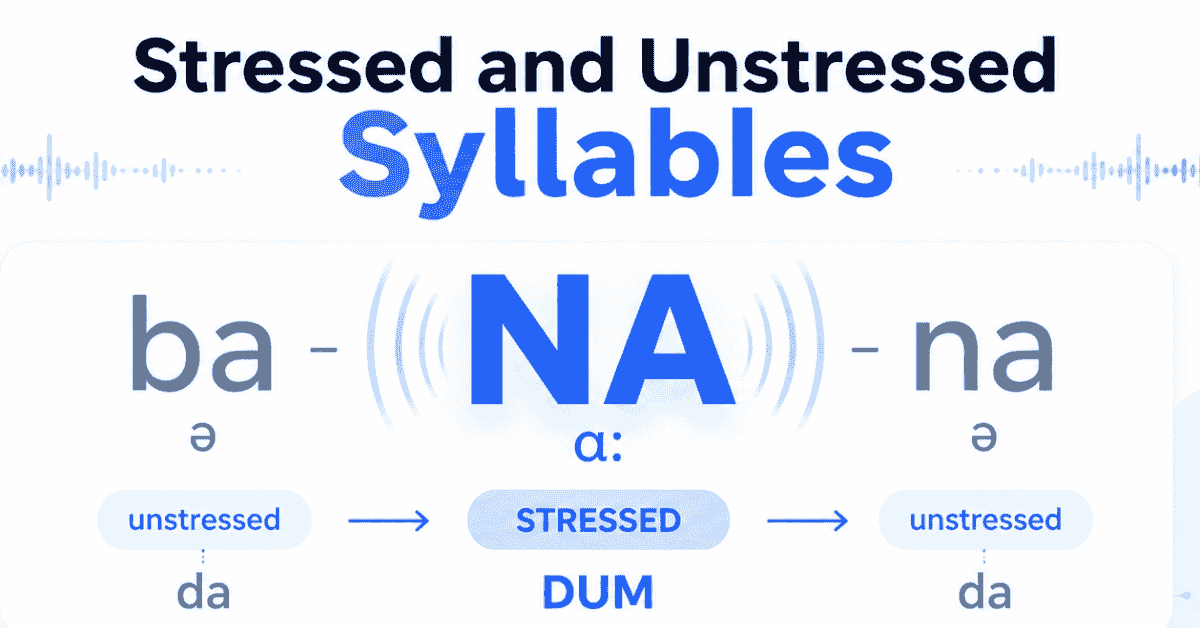
A stressed syllable is the part of a word you naturally say with more emphasis. An unstressed syllable is weaker, shorter, and often less clear. For example, say banana slowly: ba-NA-na. The middle syllable carries the main stress.
This difference matters in pronunciation, poetry, songwriting, and meter. Hearing stressed and unstressed syllables helps you pronounce words naturally and understand why equal syllable counts can still produce different rhythms.
What Is a Stressed Syllable?
A stressed syllable usually sounds stronger than the syllables around it. It may be longer, louder, clearer, or slightly higher in pitch. These are recognized features of English word stress.
| Word | Stress pattern | Stressed syllable |
|---|---|---|
| table | TA-ble | first |
| about | a-BOUT | second |
| computer | com-PU-ter | second |
| banana | ba-NA-na | second |
| photograph | PHO-to-graph | first |
The weak beats are unstressed syllables. In natural English, their vowel sounds may also reduce toward the schwa sound /ə/.
1. Say the Word Naturally, Not Too Slowly
The easiest test is to say the word as you normally would. Do not stretch every syllable equally because that can hide its natural pattern.
Try computer. Most speakers naturally say com-PU-ter. British Council uses the same second-syllable stress pattern when explaining English stress.
Now deliberately say COM-pu-ter or com-pu-TER. Both versions feel unusual. That contrast helps your ear notice the real word stress.
If you are unsure, repeat the word inside a normal sentence. Natural speech often makes the stress easier to hear.
2. Listen for Length, Loudness, Pitch and Clarity
Stress is not only volume. A stressed syllable normally combines several audible signals. Pronunciation resources identify increased duration, loudness, pitch movement and clearer vowel quality among the main cues.
Listen for:
- longer duration
- slightly louder delivery
- clearer vowel quality
- noticeable pitch movement
- stronger overall emphasis
An unstressed syllable tends to be shorter and less prominent.
This is why simply asking, "Which part is loudest?" sometimes fails. Listen for the complete sound pattern.
3. Try the Call-Out Test
Imagine your friend is across a busy room. Call the word as if you need them to hear it clearly.
For Amanda, you will probably say a-MAN-da. For banana, ba-NA-na. For important, im-POR-tant.
The syllable receiving the strongest natural push is usually the primary stress.
Exaggeration makes the hidden rhythm easier to hear.
4. Use a Dictionary When Your Ear Is Unsure
English syllable stress has patterns, but it also has exceptions. A pronunciation dictionary is the safest check when a word sounds ambiguous. Both educational and poetry resources recommend dictionaries when identifying established word stress.
Many dictionaries place a stress mark before the stressed syllable. In phonetic transcription, ˈ normally identifies primary stress. Longer words may also contain secondary stress and several unstressed syllables.
Before marking stress, it helps to divide the word correctly. Use CountFlows' Syllable Division Rules guide for VC/CV, V/CV, suffixes, prefixes, and other practical patterns.
5. Watch for Words That Change Stress
Stress is usually stable inside a word, but it is not identical in every use.
Consider record:
- RE-cord — noun: "I bought a record."
- re-CORD — verb: "Please record the meeting."
The spelling stays the same, but the stress on the syllable changes with the word's function. Similar noun–verb stress shifts occur in English, and British Council specifically teaches this distinction.
6. Separate Word Stress From Sentence Stress
A common mistake is treating every word as if it carries identical emphasis in every sentence.
Inside a multi-syllable word, word stress is normally fairly stable. Inside a sentence, whole words can become more prominent because of meaning or contrast.
Compare:
- "I CAN do it."
- "I can DO it."
The spelling has not changed, but the sentence emphasis has.
Dictionary stress gives the normal word pattern. Poetic meter shows how stresses work together across an entire line.
7. Mark the Stress Pattern in Poetry
In poetry, stressed and unstressed syllables create meter. Poetry resources commonly mark stressed syllables with / and unstressed syllables with x, U, or a breve depending on the notation system.
An iamb follows:
x /
unstressed → stressed
da-DUM
A trochee reverses it:
/ x
stressed → unstressed
DUM-da
Other common feet include the anapest (x x /) and dactyl (/ x x).
Traditional iambic pentameter normally contains five iambic feet, creating the familiar da-DUM rhythm associated with English sonnets. Your existing sonnet guide already makes the important distinction that syllable count measures how many syllables occur, while meter measures how the stresses are arranged.
Stressed Syllable vs Syllable Count
Counting syllables and identifying stress are related, but they are not the same task.
Two lines can each contain ten syllables. One may follow smooth iambic pentameter, while another places its strongest beats awkwardly.
The distinction is simple:
- Syllable count = how many spoken beats exist.
- Syllable stress = which beats receive emphasis.
Use the CountFlows Syllable Counter to check each word or poetry line first. The tool already provides per-word and per-line counts and supports poetry patterns such as haiku. Then read the line aloud or consult pronunciation data to identify its stress.
Best Way to Check Syllable Stress Online
A useful syllable stress checker should really solve two different problems: identifying the syllables and identifying which syllable receives primary or secondary stress.
Do not assume a general AI chatbot will always get both right. Pronunciation can involve exceptions, reduced vowels, accent differences, and context.
For practical work, use a syllable counter for the count and a pronunciation dictionary or audio example for the stress. CountFlows' guide on why AI chatbots struggle to count syllables explains why automated language tools can still make mistakes in this area.
Are Stressed and Unstressed Syllables Subjective?
Not completely.
Within ordinary English words, lexical stress is usually established by normal pronunciation. Reddit discussions around poetry repeatedly show that the confusion often begins when writers mix normal dictionary stress with the stress pattern of an entire poetic line.
Context can still change emphasis. Some words change stress with grammatical use, while poetry can create tension between ordinary speech and meter.
The safest rule is simple: start with normal pronunciation, then examine the sentence or poetic line around it.
Quick Practice: Which Syllable Is Stressed?
Try these before checking the answers:
- hotel
- apple
- computer
- banana
- record — noun
Answers:
- ho-TEL
- AP-ple
- com-PU-ter
- ba-NA-na
- RE-cord
Now say each word with the stress reversed. The awkward version often makes the correct pattern obvious.
Conclusion
Understanding stressed and unstressed syllables is less about memorizing complicated rules and more about learning to hear English rhythm.
Start by saying the word naturally. Listen for length, loudness, pitch, and vowel clarity. Use a dictionary when needed, and remember that word stress, sentence emphasis, and poetic meter are connected but different concepts.
For poetry, first check the count with the CountFlows Syllable Counter. Then read the line aloud and mark its strong and weak beats. That two-step method keeps counting and stress analysis separate.
Frequently Asked Questions
What is a stressed syllable?
A stressed syllable has more importance than other adjacent syllables. This syllable is longer, clearer, louder or even has a pitch variation.
What is an unstressed syllable?
An unstressed syllable is less emphasized. It is relatively shorter and also weak, and it may also have a reduced vowel sound in a sentence.
How do I identify which syllables are stressed?
Speak the word naturally and pay attention to its strong beat. If you are still confused about which one to choose, consult a pronunciation dictionary.
Can a word have two stressed syllables?
Longer words can contain primary stress and secondary stress, although one syllable normally carries the main emphasis.
Is syllable stress the same as meter?
No. Syllable stress describes prominence in speech. Meter describes an organized rhythmic pattern of stressed and unstressed syllables across poetry.
Can stress change the meaning of a word?
Yes. In some English words, moving the stress accompanies a change in grammatical function or meaning, such as noun–verb pairs.
Related Articles
Continue with closely related CountFlows guides.
Writing & Education
Academic Writing Guide: Structure, Examples & Tips for Students
A practical guide to academic writing, including structure, evidence, paragraph building, assignment command words, examples, citations, and editing.
Writing & Education
Essay Word Count Guide: How Long Is an Essay? (By Level)
Word count problems start at the outline stage, not the writing stage. Learn essay lengths by level, paragraph word counts, the exact 10% rule for common lengths, and where your word count actually goes.
Writing & Education
How Many Pages Is 2,000 Words? Single & Double Spaced
A standard page holds about 500 words single-spaced or 250 words double-spaced. See page estimates for essays, books, handwriting, speeches, and common word counts.