Topics Covered:
Helpful tools for this guide
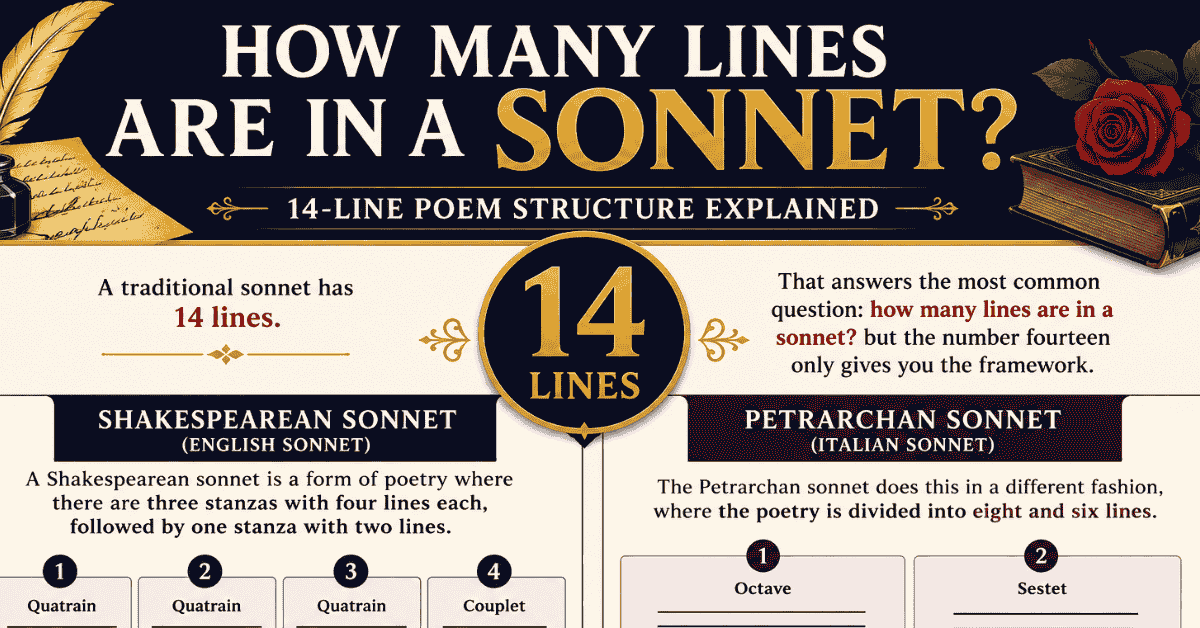
Quick answer: a traditional sonnet has 14 lines. What changes from one sonnet form to another is how those fourteen lines are organized.
A Shakespearean sonnet usually uses three four-line sections followed by a two-line couplet. A Petrarchan sonnet divides the poem into an eight-line octave and a six-line sestet. A Spenserian sonnet also uses fourteen lines, but links its quatrains through an interlocking rhyme scheme.
Line count is only the starting point. If you are reading, studying, or writing a sonnet, you also need to look at the poem's rhyme, meter, turn of thought, and development of its central idea.
Sonnet Structure at a Glance
| Form | Lines | Typical Structure | Common Rhyme Scheme |
|---|---|---|---|
| Shakespearean | 14 | 4 + 4 + 4 + 2 | ABAB CDCD EFEF GG |
| Petrarchan | 14 | 8 + 6 | ABBAABBA + variable sestet |
| Spenserian | 14 | 4 + 4 + 4 + 2 | ABAB BCBC CDCD EE |
If you only need the answer for homework or a quiz, remember:
Traditional sonnet = 14 lines.
Why Does a Sonnet Have 14 Lines?
The fourteen-line structure comes from the historical development of the form rather than from a general rule about poetry.
The sonnet originated in Italy. The word comes from sonetto, meaning a small song or sound. The form later developed into several traditions, particularly the Italian or Petrarchan sonnet and the English or Shakespearean sonnet.
Poetry Foundation describes the sonnet as a fourteen-line poetic form with a variable rhyme scheme. The Academy of American Poets likewise describes the traditional form as fourteen lines, usually organized through a tight thematic structure.
What is interesting is not merely that poets accepted a fourteen-line limit. It is what that limit forces them to do.
There is very little room to wander. A poet usually has to establish an idea, develop it, introduce some kind of change, and reach an ending within a small space.
Is Every 14-Line Poem a Sonnet?
No. Having fourteen lines makes a poem sonnet-length, but line count alone does not necessarily make it a traditional sonnet.
Consider two poems:
| Poem A | Poem B |
|---|---|
| 14 lines | 14 lines |
| No planned structure | Organized into quatrains and a couplet |
| No consistent rhyme or meter | Uses a recognizable rhyme pattern |
| Same thought continues throughout | Develops an idea and introduces a turn |
Poem B is much closer to a traditional sonnet.
Modern poetry complicates this distinction because poets deliberately bend established forms. So the better question is not simply:
Does this poem have fourteen lines?
Ask:
What sonnet conventions is this poem using, modifying, or deliberately rejecting?
Shakespearean, Petrarchan, and Spenserian Sonnets Compared
| Feature | Shakespearean | Petrarchan | Spenserian |
|---|---|---|---|
| Lines | 14 | 14 | 14 |
| Main division | 3 quatrains + couplet | Octave + sestet | 3 linked quatrains + couplet |
| Basic formula | 4 + 4 + 4 + 2 | 8 + 6 | 4 + 4 + 4 + 2 |
| Typical rhyme | ABAB CDCD EFEF GG | ABBAABBA + variable sestet | ABAB BCBC CDCD EE |
| Closing couplet | Yes | Usually no | Yes |
| Typical movement | Idea develops through three stages, then closes | Opening proposition or problem followed by response | Quatrains flow into one another through linked rhymes |
How Is a Shakespearean Sonnet Structured?
The Shakespearean, or English, sonnet has:
- 14 lines
- 3 quatrains of 4 lines each
- 1 final couplet of 2 lines
- a traditional rhyme scheme of ABAB CDCD EFEF GG
- traditionally, iambic pentameter
In numbers:
4 + 4 + 4 + 2 = 14
Lines 1 to 4: establish
The first quatrain normally gives the reader something to work with. It may introduce a comparison, question, image, conflict, memory, or argument.
Lines 5 to 8: develop
The second quatrain does more than repeat the opening. It can add evidence, complicate the original thought, change the image, or push the argument further.
Lines 9 to 12: shift or deepen
The third quatrain often brings a new pressure into the poem. Something may change in the speaker's understanding, even when the major turn comes later.
Lines 13 to 14: make the couplet matter
The final two lines are not simply a summary box.
A strong couplet can resolve the argument, expose an irony, overturn an earlier assumption, or leave the reader with a sharper version of the poem's central idea.
How Is a Petrarchan Sonnet Structured?
The Petrarchan, or Italian, sonnet also has fourteen lines, but its internal architecture is different:
8 + 6 = 14
The first eight lines form the octave. The final six lines form the sestet.
The octave
The octave often establishes a situation such as:
- a problem;
- a desire;
- a contradiction;
- a question;
- an emotional conflict;
- or a proposition.
A common rhyme scheme is:
ABBAABBA
The sestet
The final six lines respond to what came before. The speaker might rethink the problem, offer an answer, accept something, reject an earlier belief, or look at the subject from a new angle.
Common sestet patterns include:
- CDECDE
- CDCDCD
- CDEDCE
The sestet rhyme is more flexible than the octave.
What Makes a Spenserian Sonnet Different?
The Spenserian form resembles the Shakespearean form in its overall division:
4 + 4 + 4 + 2
But its rhyme scheme is:
ABAB BCBC CDCD EE
The key feature is the way one quatrain passes a rhyme into the next:
ABAB → BCBC → CDCD → EE
That interlocking pattern can make the poem feel more continuously woven together than a Shakespearean sonnet, where each quatrain introduces a new rhyme pair.
What Is the Volta in a Sonnet?
The volta is the turn in the poem: the point where the thought, emotion, argument, or perspective changes.
Imagine the first part of a poem arguing:
Time destroys everything beautiful.
Then the poem changes direction:
But poetry can preserve what time destroys.
The subject is still time and beauty. What changed is the speaker's understanding of them.
That is a volta.
In a Petrarchan sonnet, the turn is strongly associated with the movement from octave to sestet, around line 9. In English sonnets, an important shift can also occur around line 9, while the final couplet may create an additional turn or conclusion.
Poetry Foundation describes the sonnet in terms of this proposition and resolution movement, with the volta separating the two stages.
How Many Syllables Are in a Sonnet?
There is no universal total number of syllables that every sonnet must contain.
A traditional English sonnet written in regular iambic pentameter often has about ten syllables per line.
If all fourteen lines contain exactly ten syllables:
14 × 10 = 140 syllables
So 140 is a useful mathematical reference for a completely regular ten-syllable, fourteen-line poem.
It is not a universal sonnet rule.
Historical poems can contain metrical substitutions, contractions, pronunciation differences, and occasional extra syllables.
If you are checking your own draft, use the CountFlows Syllable Counter to identify lines that deserve closer inspection.
Ten Syllables Is Not the Same Thing as Iambic Pentameter
This distinction is easy to miss.
Syllable count tells you roughly how many spoken units are in a line.
Meter tells you how those syllables are rhythmically stressed.
An iamb normally moves from an unstressed syllable to a stressed one:
da-DUM
Pentameter means five metrical feet, so a regular iambic line can be represented approximately as:
da-DUM | da-DUM | da-DUM | da-DUM | da-DUM
Folger Shakespeare Library notes that Shakespeare's sonnets are generally based on iambic pentameter while also showing considerable rhythmic variation inside that pattern.
This gives you a useful editing rule:
Count the syllables, then read the line aloud.
A line can contain ten syllables and still sound nothing like convincing iambic pentameter.
A Practical 14-Line Map for Writing a Shakespearean Sonnet
Instead of beginning with rhyme words, plan what the poem needs to accomplish.
| Lines | Structural Job | Question to Ask Yourself |
|---|---|---|
| 1–2 | Open the subject | What question, image, or tension makes this worth reading? |
| 3–4 | Complete the opening thought | What does the reader need to understand before I move on? |
| 5–8 | Develop or complicate | What makes the opening idea less simple than it first appeared? |
| 9–12 | Turn or deepen | What changes in the speaker's understanding? |
| 13–14 | Close with consequence | What can I now say that I could not have said in line 1? |
That last question is particularly useful.
If the final couplet could have appeared at the beginning without changing anything, the poem probably has not developed enough.
Is My 14-Line Poem Actually Working as a Sonnet?
Use this diagnostic instead of checking the line count alone.
| Check | Question | If the Answer Is No |
|---|---|---|
| Line count | Am I intentionally working with the traditional 14-line frame? | Decide whether you are writing a sonnet or a variation on one. |
| Form | Can I identify the structural pattern I am using? | Choose Shakespearean, Petrarchan, Spenserian, or a deliberate modern variation. |
| Development | Does the poem move somewhere rather than repeat one idea? | Give each section a different job. |
| Volta | Does something meaningful change? | Find the moment where the speaker learns, questions, rejects, or reinterprets something. |
| Rhyme | If I am using formal rhyme, does it support the sentence rather than distort it? | Rewrite the thought before forcing a rhyme word into place. |
| Meter | If I am aiming for meter, does the line sound natural aloud? | Check stress, not just the syllable total. |
| Ending | Does the ending add something the opening did not know? | Strengthen the consequence of the volta. |
A poem does not have to pass every traditional check to have value. The point of this diagnostic is to help you distinguish an intentional variation from an accidental one.
How to Write a Sonnet Without Making It Sound Forced
1. Choose the argument before the rhyme
"Love," "time," or "nature" is a subject, not yet a poem.
A more useful starting idea might be:
Time changes physical things, but memory changes what those losses mean.
Now you have something that can develop across fourteen lines.
2. Choose a form that suits the thought
If you want several stages followed by a sharp closing statement, a Shakespearean structure may fit naturally.
If your idea works as problem followed by response, the octave-and-sestet architecture of a Petrarchan sonnet may be more useful.
3. Plan the volta before polishing line 1
Ask yourself what the speaker believes near the beginning and what the speaker understands differently near the end.
That gives the poem movement before you start worrying about perfect rhyme.
4. Draft for meaning first
Forced rhymes often happen because the writer chooses the rhyme before deciding what the sentence actually needs to say.
Draft the thought. Then adjust sentence order, vocabulary, and line endings until the rhyme works without sounding imported from another poem.
5. Check syllables, then stress
If you are aiming for traditional English meter, use the Syllable Counter to flag unexpectedly short or long lines.
Then read those lines aloud.
The tool can help with quantity. Your ear is still needed for rhythm.
6. Rewrite the ending separately
Give the final couplet or sestet its own editing pass.
Ask whether it merely restates the poem or whether it changes the reader's understanding of what came before.
A Better Way to Check a Sonnet Draft
Do not try to verify everything in one pass.
Use four separate checks.
- Structure check: count the lines and identify the sections.
- Rhyme check: label the end sounds A, B, C, and so on.
- Rhythm check: inspect syllables, then read the poem aloud for stress.
- Meaning check: identify the opening idea, the turn, and what has changed by the end.
The fourth check is the one mechanical tools cannot fully do for you.
A poem can contain exactly fourteen lines, follow a perfect rhyme scheme, and hit ten syllables on every line while still having no meaningful development.
Technical correctness and poetic movement are related, but they are not the same thing.
Do Modern Sonnets Have to Follow All of These Rules?
No.
Traditional definitions give you a stable baseline: fourteen lines, recognizable structure, meter or rhyme conventions, and some form of turn.
But poets have been modifying the form for a long time.
Folger explicitly notes that sonnet writers have been bending and breaking the form for centuries. Poetry Foundation also documents variations such as Spenserian sonnets, sonnet sequences, submerged sonnets, crowns of sonnets, and stretched forms that extend beyond the standard length.
This creates an important distinction:
A traditional sonnet follows recognizable conventions. A modern sonnet may deliberately alter them while remaining in conversation with the form.
Breaking a rule intentionally is different from not knowing the rule existed.
Common Mistakes When Learning or Writing Sonnets
| Mistake | Better Understanding |
|---|---|
| Every 14-line poem is automatically a traditional sonnet | Line count is only one feature of the form. |
| Every sonnet contains exactly 140 syllables | 140 assumes fourteen lines of exactly ten syllables each. |
| Ten syllables automatically means iambic pentameter | Meter depends on stress as well as syllable quantity. |
| The volta must always occur in exactly one location | Its typical location depends on the form and poem. |
| A Shakespearean couplet just summarizes the poem | It can resolve, reverse, complicate, or sharpen the argument. |
| The rhyme scheme matters more than meaning | Formal accuracy cannot rescue an idea that never develops. |
The CountFlows 5-Part Sonnet Check
When reviewing a sonnet, use these five questions:
- Frame: Does the poem use the intended line structure?
- Pattern: Does its rhyme or sectional organization fit the chosen form?
- Pulse: Does the intended meter work when the lines are spoken?
- Turn: Can you identify what changes in the poem?
- Payoff: Does the ending make the journey through those fourteen lines worthwhile?
This is a practical CountFlows editing framework, not a historical rule of sonnet composition.
Sources and Method
The traditional structures in this guide are based on established poetry references rather than a single modern SEO definition.
Bottom Line
A traditional sonnet has 14 lines.
For the Shakespearean form, remember:
14 lines → 3 quatrains + couplet → ABAB CDCD EFEF GG
For the Petrarchan form:
14 lines → octave + sestet → ABBAABBA + variable sestet
But if you are analyzing or writing a sonnet, do not stop at fourteen. Look for the movement of the poem: how the idea begins, where it turns, and what becomes possible by the final line that was not possible in the first.
If you are writing your own poem, use the CountFlows Syllable Counter to check line length and the stressed and unstressed syllables guide when you need help thinking about rhythm.
Related Articles
Continue with closely related CountFlows guides.
Writing & Education
Academic Writing Guide: Structure, Examples & Tips for Students
A practical guide to academic writing, including structure, evidence, paragraph building, assignment command words, examples, citations, and editing.
Writing & Education
Essay Word Count Guide: How Long Is an Essay? (By Level)
Word count problems start at the outline stage, not the writing stage. Learn essay lengths by level, paragraph word counts, the exact 10% rule for common lengths, and where your word count actually goes.
Writing & Education
How Many Pages Is 2,000 Words? Single & Double Spaced
A standard page holds about 500 words single-spaced or 250 words double-spaced. See page estimates for essays, books, handwriting, speeches, and common word counts.