Topics Covered:
Helpful tools for this guide
Blank stare for "1347"? You're not the only one. For most people who aren't in the armed forces, medical profession, or flying planes, learning military time can be a big mystery. However, knowing just two things makes how to read military time easy for absolutely anyone. Here you get the whole picture of reading military time covered, starting from explanations to a detailed chart, examples, and even tips that really work!
What Is Military Time?
Military time involves using the 24 hour clock, whereby Hour is measured from one midnight (0000 hours) to the other midnight of the following day (2400 hours), with no resetting during the entire period of 24 hours. AM and PM do not exist in this case.
Most of the world actually uses this system. The United States, Canada, and a handful of other countries are the outliers with their 12-hour standard. Hospitals, pilots, meteorologists, emergency dispatchers, and armed forces all depend on military clocks because it eliminates any ambiguity — "3 o'clock" could mean morning or afternoon, but "1500" can only ever mean one thing.
How to Read Military Time: The 2-Rule Method
Here's the fastest way to learn how to read military time easily — you only need two rules, and you'll be fluent in under five minutes.
Rule 1 — Morning Hours Stay the Same (0000–1159)
- 1:00 AM → 0100 (spoken: "zero one hundred")
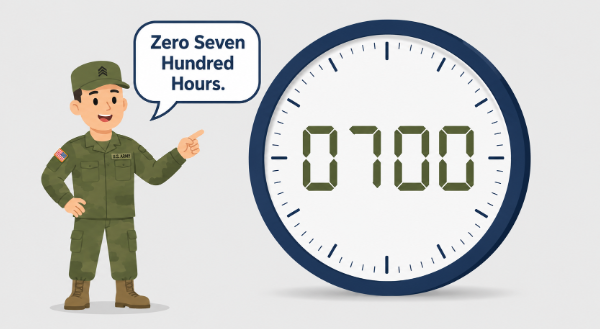
- 7:30 AM → 0730 (spoken: "zero seven thirty")
- 11:45 AM → 1145 (spoken: "eleven forty-five")
The only tricky one is midnight, which becomes 0000 (spoken: "zero hundred hours"). Noon stays at 12:00.
Rule 2 — Afternoon Hours: Add 12 (1200–2359)
- 1:00 PM → 1300
- 5:00 PM → 1700
- 9:45 PM → 2145
- 11:59 PM → 2359
Once this clicks, reading military time becomes genuinely automatic. Seeing "1630" you subtract 12 from 16, get 4, add PM — that's 4:30 PM. Done.
Military Time Chart: Full Conversion Reference
| Standard Time (12-Hour) | Military Time (24-Hour) |
|---|---|
| 12:00 Midnight | 0000 |
| 1:00 AM | 0100 |
| 2:00 AM | 0200 |
| 3:00 AM | 0300 |
| 4:00 AM | 0400 |
| 5:00 AM | 0500 |
| 6:00 AM | 0600 |
| 7:00 AM | 0700 |
| 8:00 AM | 0800 |
| 9:00 AM | 0900 |
| 10:00 AM | 1000 |
| 11:00 AM | 1100 |
| 12:00 Noon | 1200 |
| 1:00 PM | 1300 |
| 2:00 PM | 1400 |
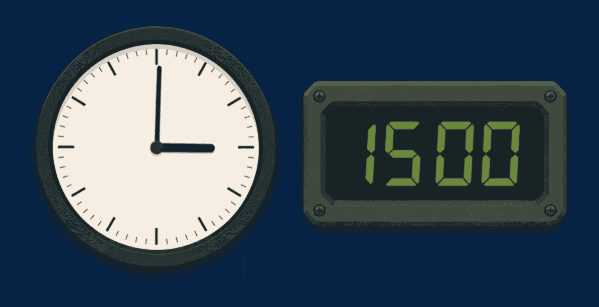
| 3:00 PM | 1500 |
| 4:00 PM | 1600 |
| 5:00 PM | 1700 |
| 6:00 PM | 1800 |
| 7:00 PM | 1900 |
| 8:00 PM | 2000 |
| 9:00 PM | 2100 |
| 10:00 PM | 2200 |
| 11:00 PM | 2300 |
| 12:00 Midnight | 2400 |

How to Convert Military Time to Standard Time
- Step 1: Split the number. Example: 1847 → hours: 18, minutes: 47.
- Step 2: Apply the hour rule. If 13 or above, subtract 12. 18 − 12 = 6 → 6:47 PM.
- Step 3: Handle edge cases:
- 0000 → 12:00 AM
- 1200 → 12:00 PM
- 2400 → 12:00 AM
How to Convert Standard Time to Military Time
The opposite method is even more straightforward. Let me show you how to convert standard hours into military hours. For the morning hours, one should simply take off the colon, and add a zero if required. So 8:15 AM would become 0815, and 11:30 AM would be converted into 1130. Midnight (12:00 AM) should be represented as 0000, but never 1200. For afternoon hours, one adds 12 to the hours and then writes down minutes after them, without a colon. Thus, 3:22 PM would be 3+12=15 and 22, making 1522. As for 11:55 PM, that would be 11+12=23 and 55, making 2355. For a deeper understanding, the Check the Time and Date website offers a reliable 24-hour clock reference guide worth bookmarking .
How to Pronounce Military Time Correctly
- 0100 → "Zero one hundred hours" (or "oh one hundred")
- 0730 → "Zero seven thirty"
- 1200 → "Twelve hundred hours"
- 1545 → "Fifteen forty-five"
- 2000 → "Twenty hundred hours"
- 0000 → "Zero hundred hours" or "midnight"
Where Is Military Time Used?
- Military and defense: Operations, orders, and logs.
- Healthcare: Hospitals and pharmacies.
- Aviation: Pilots and air traffic controllers.
- Emergency services: Police, fire, paramedics.
- Meteorology: Forecasts and satellite data.
- Computing: System logs and servers.
One special variation worth knowing: Zulu time (UTC) is military time pegged to GMT. Example: "1400Z" means 2:00 PM GMT.
Tips to Practice Military Time Daily
- Switch your phone or watch to 24-hour format.
- Write appointments in military time.
- Practice with timetables or schedules.
- Create flashcards with AM/PM vs military time.
Conclusion
Reading military time feels intimidating until you realize it's built on two simple math moves: keep AM hours the same, add 12 to PM hours. Once you internalize those rules, the system stops feeling foreign and starts feeling faster and cleaner than the 12-hour alternative.
Whether you're preparing to enter the military, work in healthcare, or simply want to decode a flight itinerary without confusion, knowing how to read military time easily is a skill that pays off every single hour.
Related Articles
Continue with closely related CountFlows guides.
Academic Writing
Free Academic Writing Guide for Students, Researchers
Academic writing is a formal style of communication used in educational and research contexts...
SEO
SEO Content Writing: The 2026 Guide to Ranking on Google
A practical SEO content writing guide covering keyword research, search intent, E-E-A-T, content length data, on-page SEO, and AI search visibility.
Academic Writing
Essay Word Count Guide: How Long Is an Essay? (By Level)
Word count problems start at the outline stage, not the writing stage. Learn essay lengths by level, what counts toward the limit, and how to cut or add words without losing marks.